
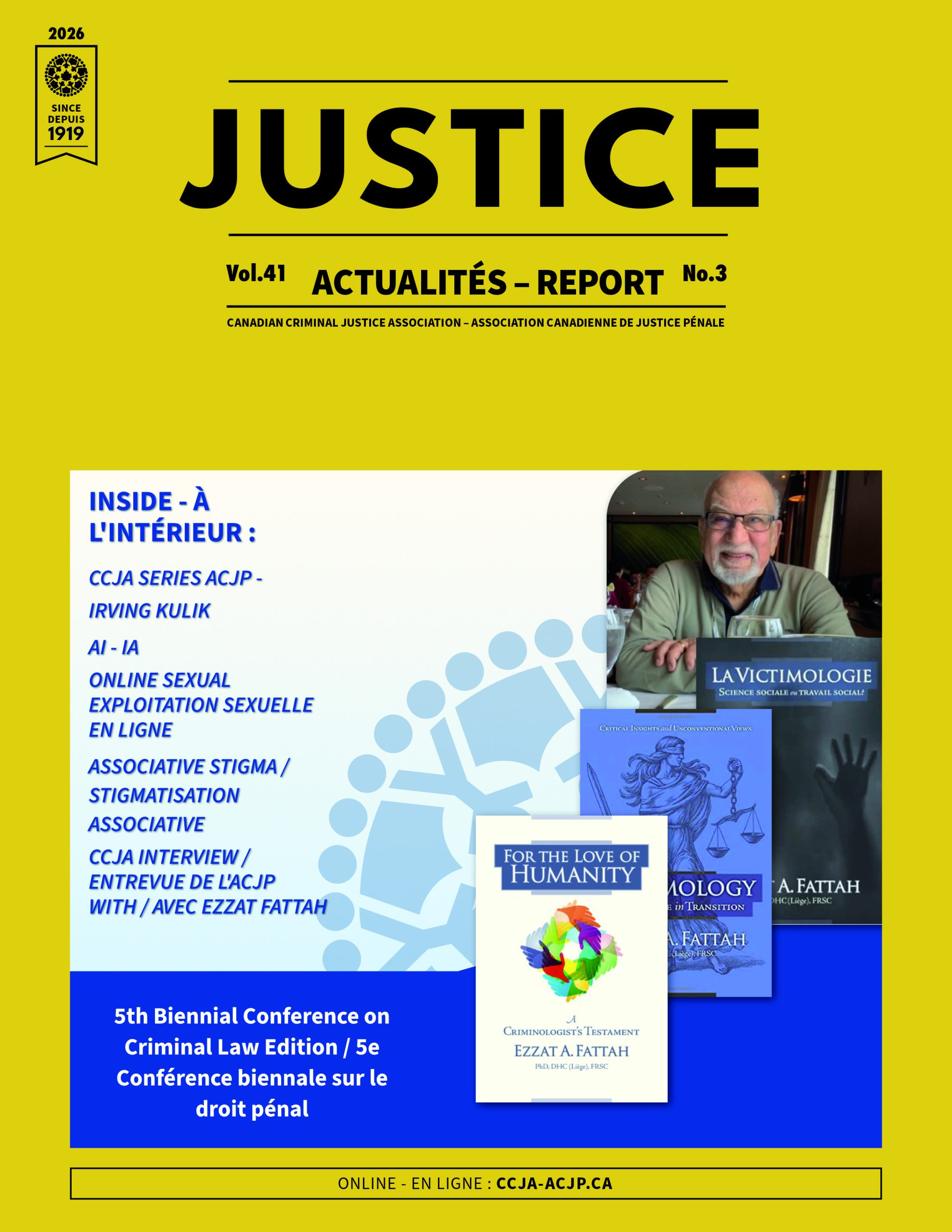
Issue 41.2
Editorial by Nancy Wright
AT THE CENTRE OF THE CCJA: IRVING KULIK’S 22 YEARS OF STEWARDSHIP
CCJA INTERVIEW WITH DR. EZZAT FATTAH–MARCH 2026
Slowing the Machine: Reclaiming Our Voice and Judgment in the Age of Artificial Intelligence
by SARAH JORGENSON AND MICHEL GAGNON
Sarah Jorgenson and Michel Gagnon question the trivialization and excessive normalization of AI. Members of the CCJA Policy Review Committee rather than AI experts, Sarah and Michel can’t help but wonder whether this new technology is being intentionally presented as if it could think for us, and whether this framing risks invalidating legitimate questions about the effects these various so-called ‘’intelligent’’ applications may have on criminal justice and on our daily lives. They emphasize that AI errors, biased datasets, and unexamined automated outputs can jeopardize people’s liberty, privacy, dignity, and the trust we should have in the justice system. The authors argue that AI systems trained on data shaped by institutional bias, a capitalist mode of production and exchange, and colonial legacies may reproduce harms while appearing neutral. The risk is not only that AI may be wrong, but that we may adopt these new technologies without allowing ourselves to question their presence in our lives. Jorgenson and Gagnon are not opposed to artificial intelligence, but they want us not to hesitate to challenge every application, however small, before uncritical reliance on AI affects our judgement, our sense of responsibility, and the regard we owe to others.
Online Sexual Exploitation in Canada: Why the Legal Response Falls Short1
by JOHN WINTERDYK, HENNES DOLTZE, & TONIA TSOULAMANIS
Drawing on a Ma Mawi Centre-sponsored study based on a CanLII review (2015–2025), surveys, and interviews with justice-sector participants, this article examines Canada’s legal response to online sexual exploitation.
Online Sexual Exploitation in Canada: Challenges in the Law Enforcement Response2
by JOHN WINTERDYK, HENNES DOLTZE, & TONIA TSOULAMANIS
Focusing on law enforcement responses, this article draws on a Winnipeg-based EmpowerMen Project study led by John Winterdyk to examine online sexual exploitation as human trafficking and its overlap with sexual assault.
Exploring Unseen Adversities: Associative Stigma among Service Providers Working with People Who Have Sexually Offended
by KALA RAFUSE
Kala Rafuse examines a largely overlooked problem: associative stigma experienced by professionals who work with people who have sexually offended (PWSO). While stigma affecting PWSO has been widely studied, far less attention has been given to its impact on those who provide treatment and supervision. Drawing on stigma and labelling theory, Rafuse suggests that service providers may face social judgment, isolation, burnout, and moral strain through association with a highly stigmatized population. She calls for qualitative research in the Canadian context to better understand this issue and to inform policy, training, and professional supports.
BOOK REVIEW of Katerina Hadjimatheou’s The Crimes of Others
by MIRANDA HENDERSON