
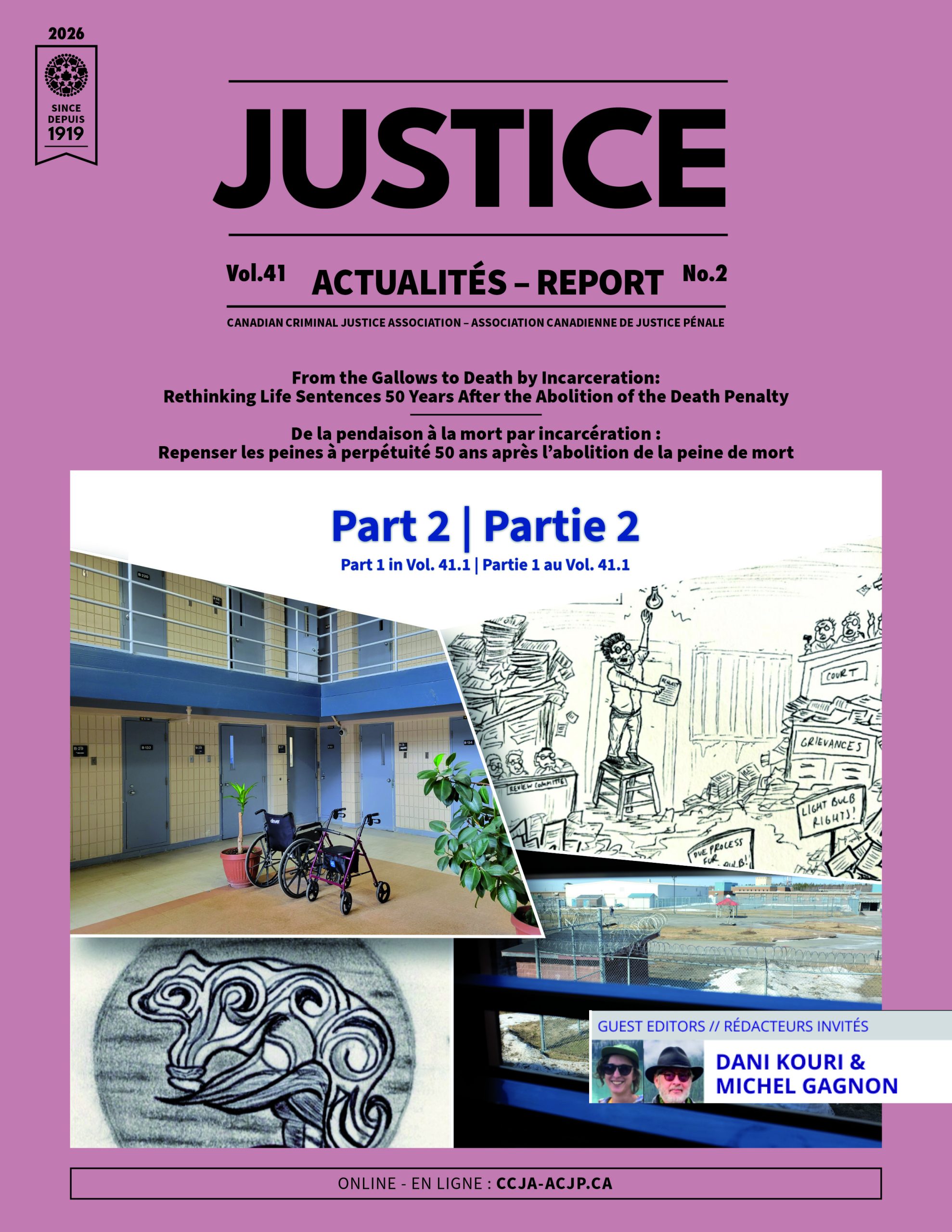
Issue 41.2
Guest Editors: Dani Kouri and Michel Ganon
Editorial by Dani Kouri & Michel Gagnon
Falling Out of the Rabbit Hole
by John Rives
This harrowing text explores the persistent fear of incarceration and its psychological toll. John Rives describes a daily terror so extreme it gave way to resignation, like cattle led to slaughter. He reflects on losing faith, dreading pain, and the senseless, wholly non-rehabilitative suffering that even his guilt can’t justify. The author expresses a deep longing to escape a future defined by horror, despair, and confinement.
Revisiting the Constitutionality of the Mandatory Life Sentence for Murder
by Debra Parkes
Debra Parkes revisits the constitutionality of Canada’s mandatory life sentence for murder fifty years after the abolition of the death penalty. She argues that the regime—mandatory life with lengthy parole ineligibility—has grown increasingly punitive and remains severe by international standards. The Supreme Court’s 1990 decision in R v Luxton upheld the sentence in part because of safeguards such as the “faint hope clause,” which have since been repealed. Subsequent legal developments— including evolving Charter jurisprudence on mandatory minimums, Gladue principles, and the Supreme Court’s recognition in R v Bissonnette that some sentences are intrinsically incompatible with human dignity—have weakened Luxton’s foundations. Parkes contends that courts have yet to confront the full constitutional implications of prolonged incarceration beyond parole eligibility, lifelong parole, and disproportionate impacts on Indigenous peoples and youth, including the broad discretion and frequent revocation practices that return lifers to custody for technical breaches rather than new crimes. She concludes that a renewed Charter challenge, grounded in lived experience and contemporary constitutional principles, is both necessary and timely.
Hope is the Anchor of Our Soul, as Certain as Death: A Drawing
by ThomasW. Riordan
In this contribution, Thomas W. Riordan presents a drawing created during his incarceration at Cowansville Institution in Quebec. Made for his sister, the drawing is accompanied by a handwritten note on the back, excerpts of which are reproduced in the article. Together, the image and note demonstrate the hope, faith, and support that endure shared between family beyond the distance created by a life sentence.
Jusqu’à ce que mort s’ensuive : peine de mort vs sentences-à-perpétuités
by Michel Gagnon
En examinant les conséquences du remplacement de la peine de mort par la perpétuité au Canada, en particulier pour les personnes âgées judiciarisées, Michel Gagnon remet en question le caractère inhumain de l’incarcération à vie, vu la souffrance et l’isolement qu’elle engendre. S’appuyant sur trente ans d’expérience à la Maison Cross Roads, Gagnon met en lumière les défis des détenus âgés et présente des programmes de réinsertion, notamment en matière de logement ainsi que le modèle d’intervention Passeport™. L’article appelle à une réflexion éthique sur les limites de la peine d’emprisonnement à perpétuité dans un contexte de vieillissement.
Bar None
by Sunny Savage
Sentence vie et gay
by Daniel Benson
Condamné à perpétuité et aujourd’hui en libération conditionnelle depuis plus de vingt-cinq ans, Daniel Benson livre un témoignage saisissant et percutant sur ce que signifie réellement une « peine à vie » au Canada. Entre 2002 et 2006, il a travaillé auprès de personnes détenues et ex-détenues pour les organismes Service Option-Vie (LifeLine) et Service Oxygène. S’appuyant sur son expérience de l’incarcération, de la stigmatisation, de l’homophobie en milieu carcéral et de la surveillance quasi permanente qui accompagne la libération conditionnelle, il montre que la véritable sanction n’est pas seulement la prison, mais la perte durable de contrôle sur sa propre existence. Son texte met en cause la promesse de réhabilitation lorsque la liberté demeure juridiquement conditionnelle, même après des décennies de réinsertion réussie.
Doing Life?
by Liana Macdonald
Drawing by Shari Heathen
Liana MacDonald reflects on her journey from trauma and incarceration to healing and reintegration. Despite lifelong parole restrictions, she advocates for forgiveness, community reintegration, and relinquishing life sentences for rehabilitated individuals. MacDonald’s story challenges public perceptions of prison and highlights the transformative power of support, responsibility, and second chances. The article is accompanied by a drawing by Shari Heathen, providing a reminder of the strength smudging and Makwā can provide in healing journeys.
Reaching In: Making the Case for Sustaining Peer-Based Supports for People with a Life Sentence
by Catherine Brooke and Anita Desai
This article traces the development and impact of peer-based support models for people serving life and long-term sentences in Canada, led by St. Leonard’s organizations. Following the abolition of the death penalty in 1976, growing concern about the reintegration of “lifers” led to the creation of the LifeLine® program in 1991, which used formerly incarcerated individuals as peer mentors to support others both in custody and in the community. Widely recognized as a best practice, LifeLine was defunded in 2012 following the withdrawal of federal funding, prompting the creation of PeerLife to sustain elements of the model. Despite demonstrated effectiveness, funding remains unstable. Catherine Brooke and Anita Desai argue that peer-based approaches are humane, cost-effective, and essential to successful reintegration, and call for sustained national investment and a coordinated strategy to meet the needs a growing population of life-sentenced individuals.
Effective Ways to Reduce Violent Crime … and Life Sentences: The Case for Prevention
by Dr. Jeffrey Bradley and Dr. Irvin Waller
Jeffrey Bradley and Irvin Waller review Canada’s abolition of the death penalty 50 years later, alongside the rise of life sentences and long-term imprisonment. They show that these approaches do not reduce violent crime and have worsened inequalities for Indigenous and racialized people. They call for evidence-informed prevention, already proven in Glasgow and Boston, which halves homicides for just 5% of current policing and justice costs. Bradley and Waller propose structural reform for more humane, effective, and equitable community safety. In their view, Canada must show clear leadership, with a minister and deputy minister tasked with building national capacity for violence prevention.
“They Don’t Give You Any Help Once You’re Out”: The Lived Realities of a Life Sentence
by Bobbie Kidd, Interviewed by Dr. Jeffrey Bradley
An interview with Bobbie Kidd, a person formerly incarcerated at the Prison for Women in Kingston, Ontario
In this narrative interview, Bobbie Kidd, an Indigenous woman sentenced to life in 1985 and incarcerated, now serving her life sentence on parole in the community, reflects on the lasting impact of a sentence that never ends. She describes how lifelong parole, stigma, and limited reintegration supports make rebuilding nearly impossible. Kidd criticizes reforms such as Creating Choices and calls for healing, housing, counselling, and community support instead of perpetual punishment.
Life with an Indeterminate Sentence: “If You’re Not Rehabilitating, How Are You Going to Reintegrate?”
by Frank Dorsey, Interviewed by Richard Miller
In this edited interview, Frank Dorsey reflects on more than four decades under an indeterminate Dangerous Offender sentence, describing the psychological impact of a punishment with no fixed release date and limited prospects for rehabilitation. Speaking with Richard Miller, he traces how early abuse, systemic neglect, and racialized experiences shaped his path into crime and incarceration. Dorsey argues that indeterminate detention often erodes hope rather than promoting change, particularly for Black prisoners, who face barriers to culturally relevant programming and mental health support. He questions whether Canada’s correctional system truly prioritizes rehabilitation, asking how reintegration is possible when meaningful treatment and preparation for release are absent. The interview raises broader concerns about public safety, fairness, and the expanding use of indefinite forms of punishment in Canada.
How many people does it take to change a light bulb in a Canadian federal prison?
by Kymner
CARTOON BY ECN
This joke, written by KYMNER (pseudonym of a person incarcerated in Bath, ON), offers satirical insight into the bureaucracy and delays associated with Canada’s federal correctional system. It is accompanied by a cartoon, by artist ECN, animating the joke.
A Change of Perspective
by EKG
Written from within a life sentence, the author urges a shift in perspective: let time pass, focus on discipline, set higher goals, rise above the darkness of confinement, and believe—day by day—that you are enough: hold tight.
On Committing Ideological Suicide
by Zakaria Amara
Within a deeply personal framework, Zakaria Amara traces the slow unravelling of an extremist worldview. Writing from his experiences in solitary confinement at Toronto’s Don Jail and later in Canada’s Special Handling Unit, Amara explores the struggle of being trapped inside an ideological worldview that is collapsing under new scrutiny, through growing understanding and moments of epiphany. Through reading and quiet moments of self-examination, he comes to see how ideology can eclipse conscience– making the act of letting that worldview go feel like a kind of inner death, precisely because conscience begins to re-emerge. This article is not an argument, but a reckoning: a rare account of what it means to abandon extremism and rebuild a self grounded in conscience rather than ideology, and to have done so within a carceral environment marked by extreme violence.
“You Have to Persist”: Lessons from a Death Penalty Abolitionist
by Graham Stewart, Interviewed by Dani Kouri
This interview with Graham Stewart, longtime leader within the John Howard Society, looks back on the abolition of the death penalty in Canada and the direction punishment has taken over the past fifty years. Stewart recalls how his perspective developed alongside other community members, learning capital punishment was not necessary for deterrence, public safety, or any purpose other than expressing anger. He shares different arguments used to successfully advocate against the death penalty’s potential return amidst national debates in the 1980s. While ending executions was an important step, he maintains that mandatory life sentences created new problems, including excessive periods of incarceration and highly restrictive and uniform parole requirements. Stewart emphasizes that a fair and effective justice system must be grounded in principles that encourage personal development, government restraint, public understanding, and peace within the community – and relies on our persistence in working towards the system we all deserve.
You Walk Towards Your Pain to Guide Others From Theirs: A Reflection on the 50th Anniversary of Prisoners’ Justice Day
by William Morris
Overview by Susan Haines
Prefaced by an overview by Susan Haines on the history of Prisoners’ Justice Day (PJD), this contribution contains the transcribed statement provided by William Morris for the 50th anniversary of PJD. Grounded in his personal experience as an incarcerated man with a life sentence, in addition to his experiences as a former Chairman of both the Millhaven Lifers’ Group and Bath Lifers’ Group, Morris highlights some of the key challenges still being experienced by prisoners despite 50 years of demands for change. He also presents ideas to respond to needs in the modern context and affirms that solidarity, unity, and action live on within and beyond prison walls.