
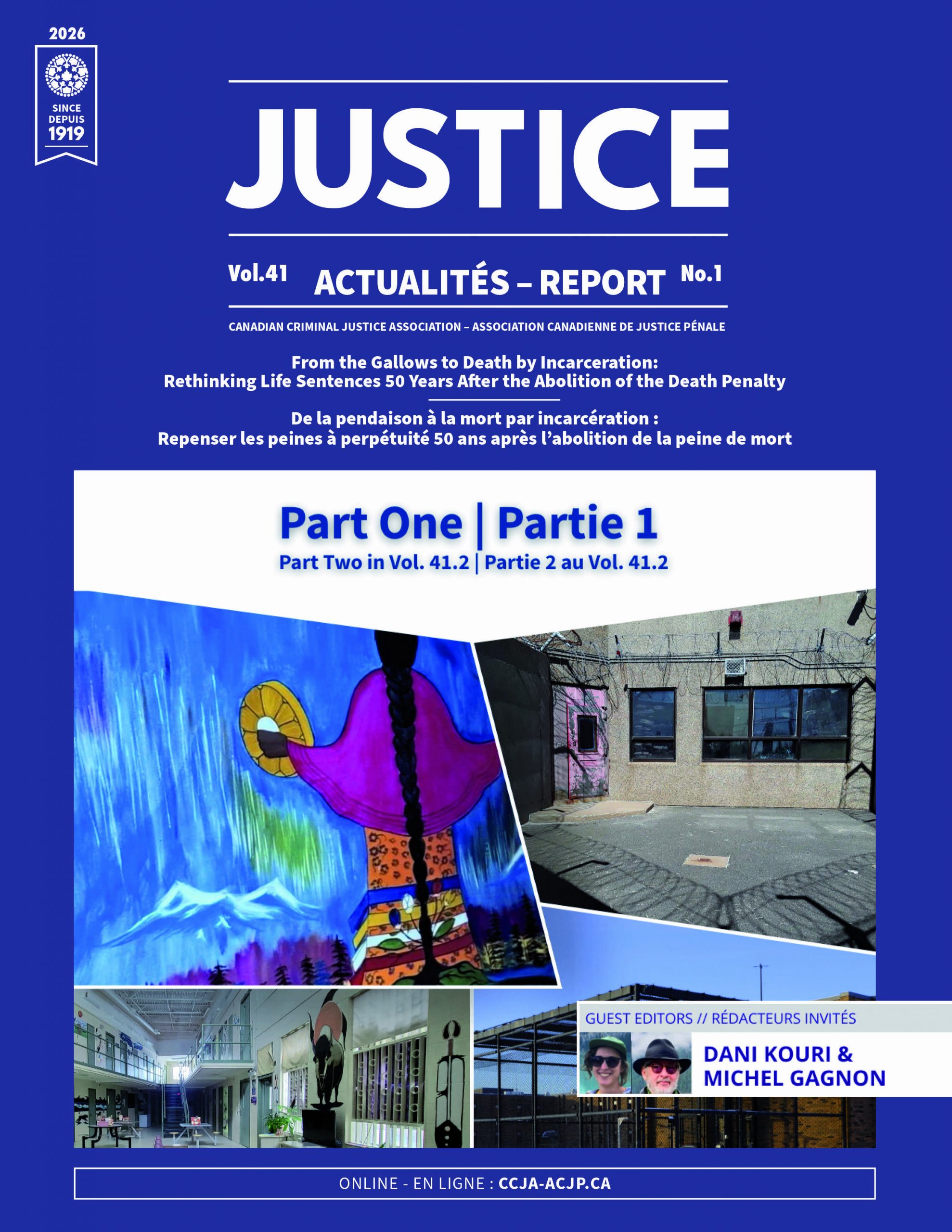
Issue 41.1
Guest Editors: Dani Kouri and Michel Ganon
Editorial by Dani Kouri & Michel Gagnon
Freedom Deferred
by Warren McDougall
Warren McDougall, a Registered Professional Counsellor (RPC) and Certified Clinical Trauma Professional (CCTP), traces a lifeline shaped by trauma, survival, and transformation – from childhood victimization and systemic failure to a life sentence, and ultimately, to healing and public service. He argues for a justice system that acknowledges early adversity and prioritizes trauma-informed, restorative responses over punishment. Despite decades of rehabilitation and leadership, McDougall remains on life parole – evidence that Canada’s justice system ultimately refuses to admit the possibility of redemption. Yet McDougall is living proof that restoration not only works but is essential to fixing Canada’s justice system, as research confirms that most federally incarcerated people were themselves victims of early violence and neglect.
Parole-for-Life in Canada: Where Punishment Never Ends
by Nyki Kish
Drawing on interviews from her study Parole-for-Life: A Qualitative Inquiry into the Canadian Life Sentence, Nyki Kish (2024) examines how Canada’s life-means-life sentencing regime extends punishment indefinitely, violating the legal principle that the correctional system is reintegrative She shows that people on parole for life – often sentenced as youth and disproportionately Indigenous – experience lifelong punishment, the reach of which extends far beyond lawful limits. Life sentenced individuals are confined to small geographic areas where their movement and their relationships are intensely regulated and monitored. These conditions perpetuate a deep social exclusion, trauma, and constant fear of reincarceration, alongside the near impossibility of living beneath restrictive conditions despite long-term stability on parole. Kish emphasizes the legal tension that while it is legally possible to remove for life sentenced people to achieve ‘parole reduced’ status, where conditions are few and reintegration is assumed, this his rarely happens in practice. She argues for ending the life sentence’s permanence though coordinated regulatory, policy, and legislative reform that create pathways for reintegration based on time and behavior in the community.
After Abolition: From Bad to Better or Bad to Worse?
by Mary E. Campbell
Mary E. Campbell, a former senior corrections policy official, examines the impact of Canada’s 1976 abolition of the death penalty. While intended as a humane reform, its rehabilitative promises have eroded. Campbell traces the repeal of the faint hope clause, harsh sentencing, and the exclusion of lifers from parole by exception. She critiques the reluctance to use relief tools like the Royal Prerogative of Mercy, and to uphold a core principle of the Corrections and Conditional Release Act: applying the least restrictive measures consistent with public safety. Without reform, she argues, the system risks being less principled than what it replaced.
L’histoire source d’espoir
by Johanne Vallée
Johanne Vallée revient sur la mobilisation citoyenne après l’abolition de la peine de mort au Canada, soulignant le rôle des bénévoles et acteurs correctionnels qui ont combattu la tentative de rétablir la peine capitale en 1987 et milité pour un traitement plus humain des condamnés à perpétuité. Elle décrit la création de programmes novateurs, de soutien entre pairs et de recommandations nationales pour la réhabilitation et le changement. Elle insiste sur l’importance de l’espoir, de la mémoire institutionnelle et de la continuité – surtout pour ceux purgeant des peines à vie.
Life After Abolition: Fifty Years of Death by Incarceration
by Rick Sauvé
Drawing on his own first-degree murder conviction and decades of work with lifers through St. Leonard’s LifeLine/PeerLife, Sauvé describes a system that expanded life sentencing, eroded parole opportunities, and disproportionately impacted Indigenous people, youth, and racialized groups. He traces the decline of
Living the Contradiction Between Healing and Punishment in Canada’s Criminal Justice System
by Menji & Mountain Rock Woman
An Indigenous woman from the Yukon reflects on nearly twenty years as a person with a life sentence, confronting the stigma of the “lifer” label, the contradiction between punishment and rehabilitation, and the deep isolation caused by poverty and distance. Her story exposes how colonial systems continue to criminalize and confine Indigenous lives, even as they claim to offer healing. Despite this, Menjia and Mountain Rock Woman affirms her identity through education, culture, sobriety, and hard-earned hope for a Tlingit future. The Faint Hope Clause legislation, rising in-prison deaths, and growing political calls for tougher penalties. Sauvé warns that Canada’s justice system has regressed, replacing execution with lifelong punishment and diminished hope.
Hope Interrupted
by Melissa Munn (Ph.D)
In Hope Interrupted, Melissa Munn, Ph.D., reflects on nearly four decades of working with life-sentenced individuals in Canada, from the optimism of the Faint Hope Clause era to the demoralizing realities of today’s correctional landscape. Drawing on her academic work, peer support initiatives like Getting Out, Staying Out (GOSO), and countless in-prison sessions, she charts how opportunities for rehabilitation and human connection have been steadily eroded. Legislative rollbacks, restrictive volunteer protocols, program inaccessibility, and the dismantling of prisoner-led groups have all contributed to a climate of hopelessness. Munn argues that while abolishing the death penalty was a moral gain, the life sentence that replaced it has become increasingly dehumanizing. Through testimonials and reflection, she calls attention to the loss of dignity, voice, and reintegration pathways for those serving life.
Another Day of Life
by Ray M
In this reflection, artist ray M describes creating his piece Another Day of Life and co-writing the song Time Rider with Hans Lanzrath – two works shaped by the relentless passage of time within a life sentence. Together, the piece and the music express how art becomes a way to inhabit, endure, and give meaning to a sentence that has no end. A link to an audio file of Time Rider is included.
Time Rider
by The Northmen (Ray M and Hans Lanzrath)
Time Rider is not a typical pop or rock composition, primarily due to its length. It is to be listened to as a rock symphony, which progresses in movements rather than in a concise format. Similarly to Another Day of Life – where the is more about the very process of the creation of it than what it represents with Time Rider, the primary point is more the very length of it rather than anything it is saying. The listener is supposed to be made to feel, to glimpse, to experience, throughout the piece what a life sentence feels like to one who is serving it.
Conversations in the Mirror
by Dirk Young
Written by Dirk Young, a man with a life sentence, this is a story that invites readers into the thoughts and emotions of a person with a life sentence who continues to apply – and be denied – for parole. Through conversations with himself in the mirror, the person in the story confronts remorse, identity, and the weight of perpetual supervision, all while holding on to hope that decision-makers will one day recognize his transformation. It is an example of how it can feel for a person with this sentence to do everything they can to move forward and still be stuck in the same place.
La clause de la dernière chance… ou comment avoir évité 4000 ans de prison à 250 Canadiens!
by Michel Dunn
Entre 1987 et 2025, la révision judiciaire est demeurée accessible aux condamnés à perpétuité avant son abolition, permettant à 250 Canadiens de demander une libération anticipée après 15 ans. Ils ont ainsi évité plus de 1 100 années d’incarcération inutile, ayant déjà purgé plus de 4000 ans. Instaurée en 1976 avec l’abolition de la peine de mort, la révision judiciaire («clause de la dernière chance») laissait les tribunaux juger de la réhabilitation. Seuls 14% ont réussi, mais beaucoup contribuent aujourd’hui à la société travailleurs, aidants, pères, arrière-grands-pères – tout en économisant environ 195 millions aux contribuables. Abolie en 2011 mais non rétroactive, elle reste possible jusqu’en 2026 pour ceux condamnés avant cette date. Sa disparition imminente mérite réflexion: 42 pour beaucoup – notamment en établissements à sécurité plus élevée – elle incarne la perte d’espoir.
L’espoir au-delà des barreaux : 13 gestion des peines d’emprisonnement à perpetuité au fédéral
by Bureau de l’enquêteur correctionnel du Canada
Extraits du Rapport annuel 2023-2024 du Bureau de Venquéteur correctionnel du Canada
La mission du Bureau de l’enquêteur correctionnel est d’assurer le traitement équitable et humain des personnes purgeant une peine fédérale. Pour ce faire, il faut attirer l’attention sur les obligations en matière de droits de la personne et tenir le SCC responsable de l’administration des services correctionnels fédéraux d’une manière conforme à la loi, aux politiques et à un processus décisionnel équitable.
Life Imprisonment Beyond Canada: Comparative Trends in Europe, Australia, and the United States
by Catherine Appleton, Zinat Jimada, and Dirk Van Zyl Smit
This article examines global trends in life imprisonment, comparing Canada’s practices to those in Europe, Australia, and the United States. Drawing on their global study, Appleton, Jimada, and Van Zyl Smit highlight a worrying rise of life imprisonment without parole and of shifting legal frameworks. While Europe emphasizes rehabilitation and the “right to hope,” the U.S. relies heavily on “death by incarceration,” and Canada has grown increasingly punitive despite the 2022 Bissonnette ruling striking down irreducible life sentences. Marking 50 years since Canada’s abolition of the death penalty, the authors call for reflection on the protection of human rights and human dignity, proportionality, and the necessity of life imprisonment as the ultimate sanction.
Room at the Inn
by John Rives
John Rives, serving a life sentence, offers a stark poetic meditation on the lived experience of incarceration in a Canadian penitentiary. Drawing from eight years in federal custody, Rives evokes the terror of the prison setting – blood-stained mattresses and the ghosts of those who came before. His writing lays bare the desolation and futility of institutions that implausibly claim to offer rehabilitation under inhumane conditions. Rives confronts the psychological toll of life in prison, describing himself and others as “forgotten sacrifices” – disposable, blemished lambs entombed in steel and concrete.